

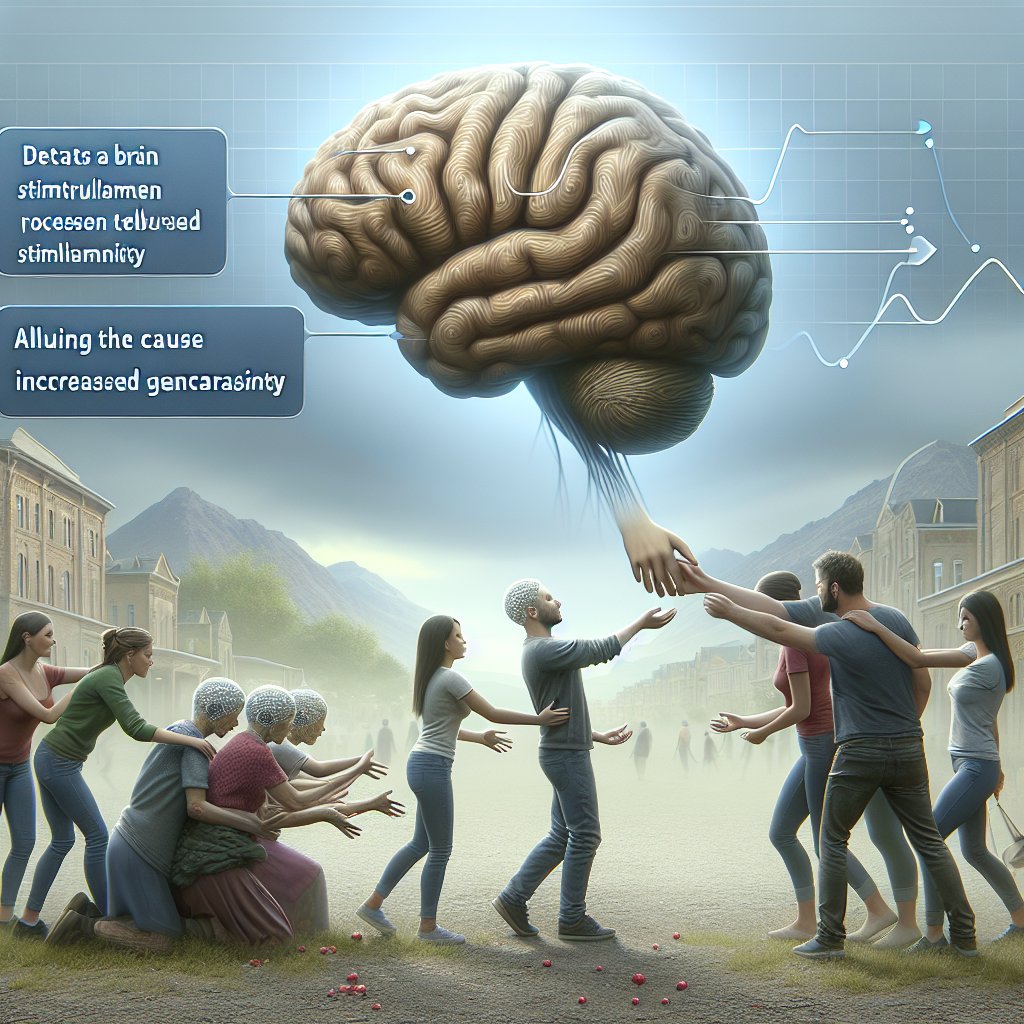
How Brain Stimulation Influences Generosity
Ever tried to teach a kid to share? It’s like pulling teeth. Scientists, however, have found a way to nudge adults towards generosity by firing up specific brain regions. A study published in PLOS Biology revealed that syncing activity between certain parts of the brain can make people act more generously. Led by Jie Hu from East China Normal University, and in collaboration with the University of Zurich, the research shows that aligning brain activity can slightly boost altruistic behavior. So, while your kid might still hoard toys, adults can be coaxed into sharing more.
The study delves into why some people are naturally generous while others are, well, Scrooge-like. We all know those folks who’d give you their last dollar, and those who’d rather watch you starve. Scientists have long pondered what drives these differences. It turns out, the answer might lie in the rhythm of our brain waves. By syncing specific brain regions, researchers found they could increase the likelihood of altruistic actions. Who knew brainwaves could be the secret sauce to generosity?
The Dictator Game and Brain Stimulation
To test their hypothesis, researchers used a Dictator Game with 44 participants. The game involved making 540 decisions about splitting money with another person. The catch? Participants could keep the cash or share it, with amounts changing each round. Talk about a moral dilemma. During these decisions, researchers applied transcranial alternating current stimulation to the frontal and parietal lobes. This noninvasive technique aimed to sync neuron firing patterns in those areas, guiding brain cells to align in repeating rhythms, either gamma or alpha oscillations.
The results were intriguing. When gamma synchrony between the frontal and parietal regions was strengthened, participants were more likely to make generous choices. They shared larger amounts of money, even if it meant taking a financial hit themselves. It seems that when these brain regions play nice together, people become more selfless. Using a computational model, the researchers discovered that the stimulation shifted how participants evaluated offers, placing more weight on others’ outcomes. Although they didn’t measure neural activity directly, the findings suggest that synchronized brain activity plays a role in deciding to be generous.
Unveiling the Cause and Effect
Christian Ruff, one of the study’s coauthors, highlighted the discovery of a communication pattern between brain regions tied to altruistic choices. This insight not only improves our understanding of how the brain supports social decisions but also lays the groundwork for future research on cooperation. Imagine the potential applications in scenarios where teamwork is crucial. It’s like finding the brain’s secret handshake for getting along.
Jie Hu, another coauthor, emphasized the study’s breakthrough in demonstrating cause and effect. Altering communication in a specific brain network using targeted, non-invasive stimulation changed people’s sharing decisions consistently. It’s a clear indication that our brain’s wiring can influence how we balance personal interests against those of others. Marius Moisa, also a coauthor, noted the striking impact of boosting coordination between brain areas, leading to more altruistic choices. When synchrony between frontal and parietal regions increased, participants were more inclined to help others, even at a personal cost.
Implications for the Future
The implications of this research are vast. Imagine a world where we can tweak brain activity to encourage cooperation and altruism. While it’s not a magic bullet for world peace, it’s a step in the right direction. Future research combining brain stimulation with electroencephalography could confirm how these interventions change brain signals. It’s like fine-tuning a radio to get the perfect station—except here, it’s about tuning the brain for better social harmony.
In a world where self-interest often prevails, finding ways to promote generosity is refreshing. The study’s findings suggest that brain stimulation could be a tool for encouraging more selfless behavior. While it’s early days, the potential applications are exciting. Whether it’s fostering teamwork in the workplace or enhancing community spirit, the possibilities are endless. So, next time you’re feeling stingy, remember, a little brain sync might just make you a modern-day Robin Hood.