Galactic Tentacles in the Cosmos
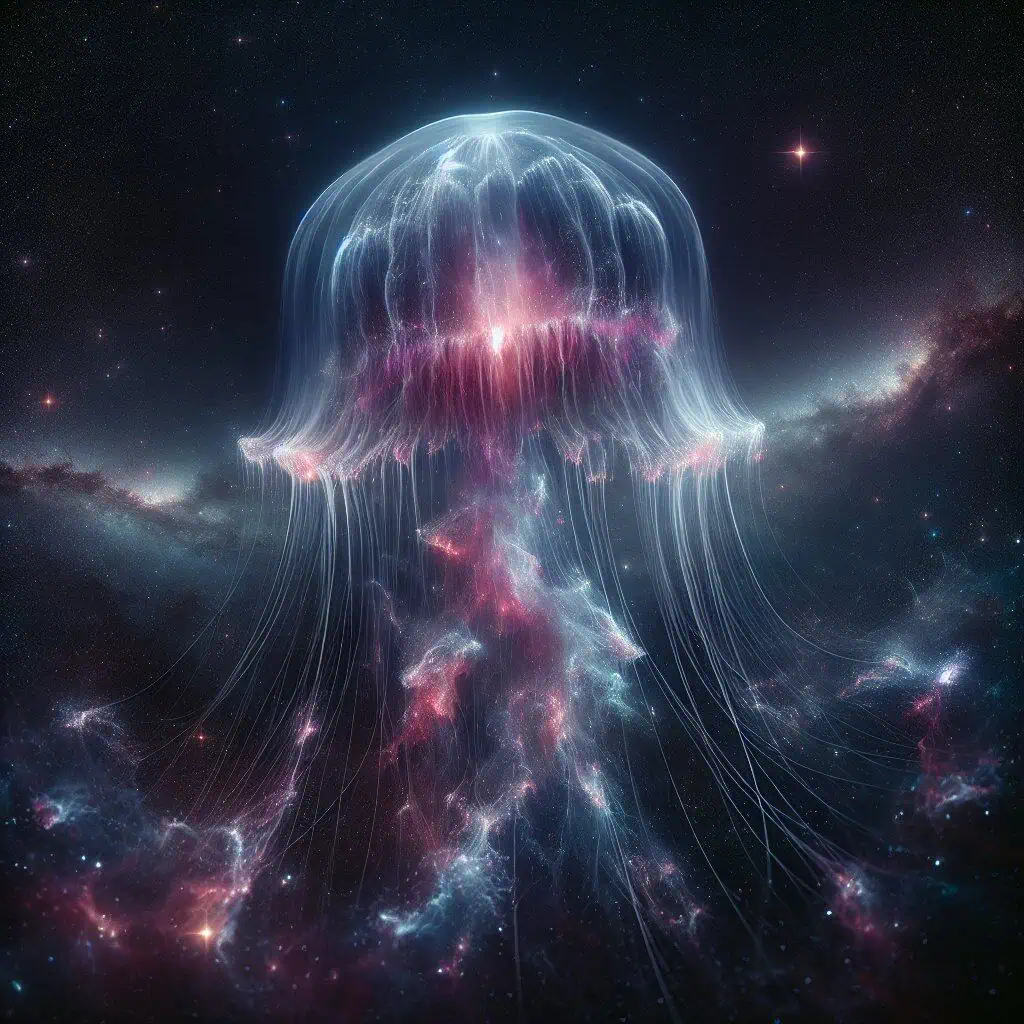
Researchers at the University of Waterloo have spotted the most distant jellyfish galaxy ever observed, thanks to the James Webb Space Telescope (JWST). These galaxies, named for their tentacle-like gas streams, offer a unique glimpse into cosmic history. As they move through galaxy clusters, they experience ram-pressure stripping, a process where surrounding hot gas pushes against them, creating trailing gas strands.
This newly identified galaxy sits at a redshift of 1.156, meaning its light has traveled 8.5 billion years to reach us. Observing it provides a snapshot of the universe’s past, raising questions about conditions 8.5 billion years ago.
A Window into the Distant Universe
The discovery was made while examining the COSMOS field, a well-studied region of the sky. This area is ideal for deep space observations due to its position away from the Milky Way’s plane, minimizing interference from nearby stars and dust. It also allows telescopes from both hemispheres to observe without obstruction from bright foreground objects.
Dr. Ian Roberts from the Waterloo Centre for Astrophysics noted, ‘We were sifting through data from this region, hoping to find unstudied jellyfish galaxies. Early in our search, we found a distant, undocumented jellyfish galaxy that sparked our interest.’
Star Formation in Stripped Gas
The galaxy itself has a typical disk shape, but the bright blue clumps along its streams are noteworthy. These are young stars, likely formed in the gas pushed away from the galaxy’s main body. This star formation pattern aligns with expectations for jellyfish galaxies undergoing ram-pressure stripping.
This discovery challenges previous assumptions about the early universe. Scientists believed galaxy clusters were still forming and that ram-pressure stripping was uncommon. The new findings suggest otherwise, indicating that cluster environments were already harsh enough to strip galaxies.
Implications for Galaxy Evolution
Studying this galaxy has implications for our understanding of galaxy clusters in the early universe. It suggests that these environments could significantly alter galaxy properties earlier than previously thought. This might explain the large population of ‘dead’ galaxies in clusters today.
If further research confirms these results, it could reshape our understanding of how dense cosmic environments influenced galaxy evolution billions of years ago. Roberts and his team have applied for more JWST observing time to explore this galaxy further.
Facts Worth Knowing
- •💡 Jellyfish galaxies are named for their tentacle-like gas streams.
- •💡 The identified galaxy’s light has traveled 8.5 billion years to reach us.
- •💡 This discovery challenges previous beliefs about galaxy cluster formation.