

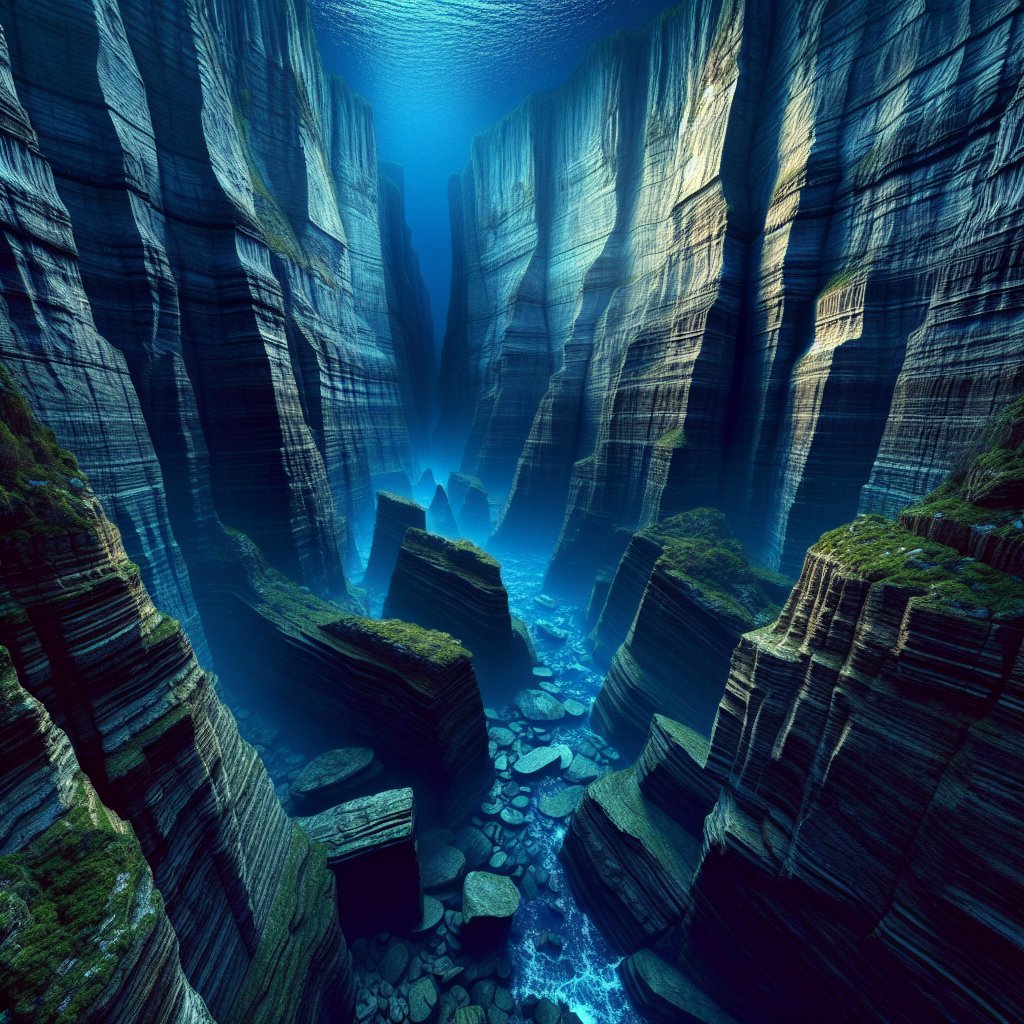
A Geological Giant Beneath the Waves
The ocean floor holds secrets that dwarf even the grandest terrestrial canyons. Among these is the King’s Trough Complex, a staggering 500-kilometer-long formation lying 1,000 kilometers off Portugal’s coast. This underwater marvel, with its intricate network of trenches and basins, challenges our understanding of geological processes. At its core lies Peake Deep, one of the Atlantic’s deepest points, a testament to the forces that shaped it.
Unlike land canyons carved by rivers, the King’s Trough owes its existence to tectonic movements. Researchers from the GEOMAR Helmholtz Centre for Ocean Research Kiel have provided new insights into this phenomenon. Their study, published in Geochemistry, Geophysics, Geosystems, reveals the forces that sculpted this underwater giant.
Tectonic Tensions: Europe’s Rift with Africa
Between 37 and 24 million years ago, the tectonic plates of Europe and Africa engaged in a celestial dance that would reshape the Atlantic floor. A temporary plate boundary ran through this region, pulling the crust apart like an undone zipper. This tectonic rifting, driven by shifting plates, forged the King’s Trough in a dramatic display of geological power.
Beneath the surface, a mantle plume—a column of molten rock—played a pivotal role. This plume, an early manifestation of the Azores mantle plume, thickened and heated the oceanic crust, weakening it. This made the region a prime candidate for tectonic activity, guiding the plate boundary’s path and halting the trough’s formation as the boundary moved south.
Mantle Mysteries: Shaping the Atlantic’s Future
The King’s Trough serves as a case study in the interplay between mantle activity and tectonic shifts. These deep processes prepare the crust for deformation, dictating where fractures and rifts emerge. The Atlantic’s geodynamic history is written in these formations, hinting at ongoing processes beneath the waves.
The Terceira Rift near the Azores mirrors these dynamics. Here, a similar trench system is developing, driven by thickened oceanic crust. This suggests that the Atlantic’s geological story is far from over, with mantle plumes continuing to influence the ocean’s evolving landscape.
Unveiling the Trough: A Scientific Expedition
The insights into the King’s Trough stem from a 2020 expedition aboard the research vessel METEOR, led by Antje Dürkefälden. High-resolution sonar mapped the seafloor, while volcanic rock samples were collected for analysis. These samples, dated at the University of Madison, revealed the trough’s complex history.
Collaborative efforts from institutions like Kiel University and Martin Luther University Halle-Wittenberg enriched the study. The data, combined with contributions from the Portuguese research center EMEPC, paints a detailed picture of this underwater wonder.
Facts Worth Knowing
- •💡 The King’s Trough Complex stretches 500 kilometers off the coast of Portugal.
- •💡 A mantle plume beneath the Atlantic contributed to the formation of the King’s Trough.
- •💡 The Terceira Rift near the Azores is a similar trench system forming today.